Field Reports · 5 min read
Eight Clips From the Hardstyle Floor: Color First, Detail Last
Color arrives first in these clips, and detail leaves last. Skin goes orange under red light, the walls stay cyan, the lasers stay green, and the lowest tones sink toward dark…

Eric StaffOfficial FestivalLUTs staff. Only the people who run this site carry this badge.
Color arrives first in these clips, and detail leaves last. Skin goes orange under red light, the walls stay cyan, the lasers stay green, and the lowest tones sink toward dark teal and then toward black. Across eight clips from one party, the same trade shows up: the grade commits hard to color, and the shadows pay for it.
Run in order, the clips move from single faces to the full crowd and back into the bodies.
Color: every light keeps its own hue
In the first clip, the red wash does not neutralise on the skin. It turns the arms and shoulders orange-red and leaves a teal-gray haze behind them. The grade lets each light keep its character instead of correcting it back to white.
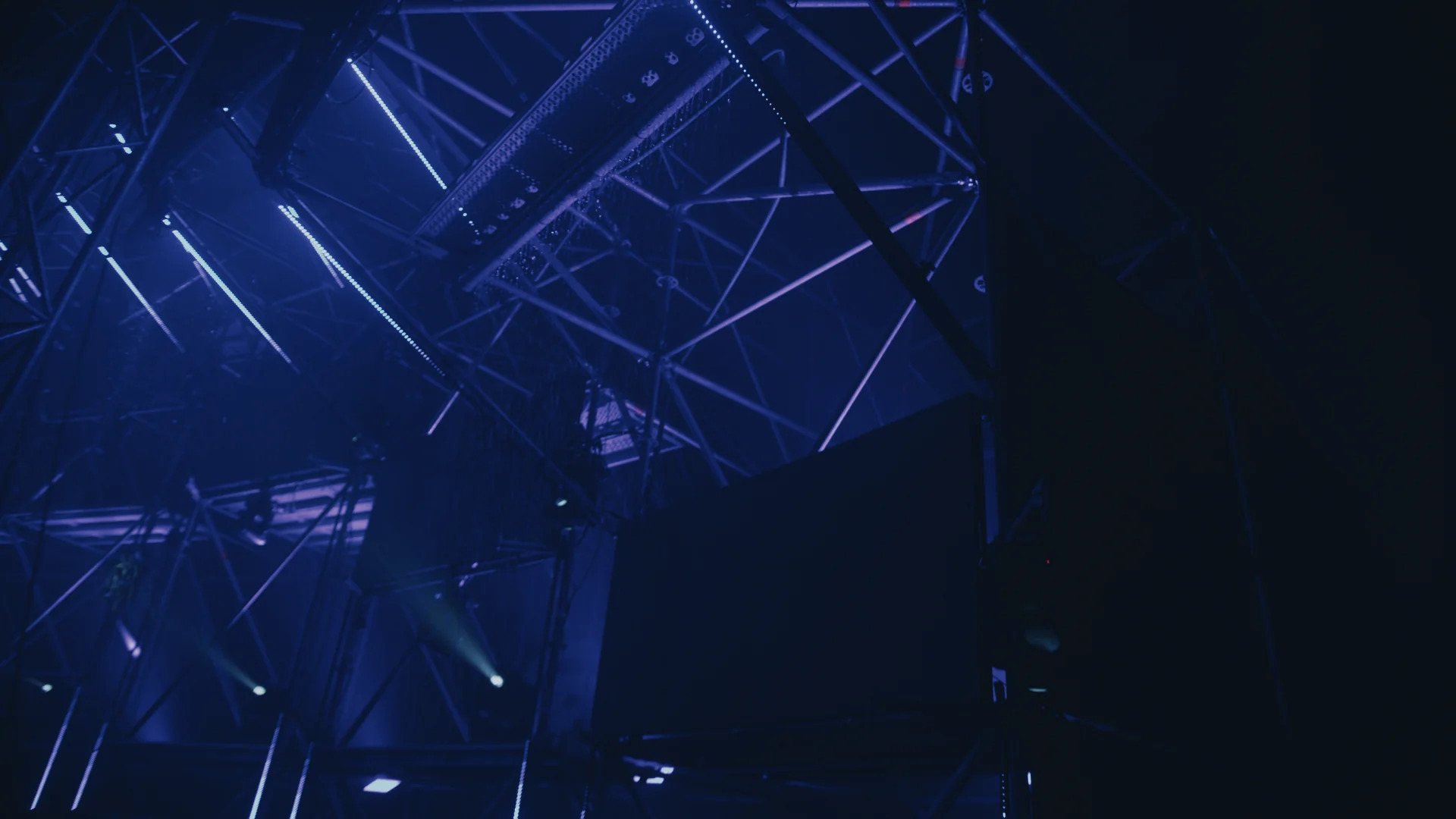
The cyan LED wall in the second clip is almost pure cyan. Its brightest panels bloom toward white at the top of the frame, while the dancer sits in blue and violet, with magenta-lilac light spilling in from the right.
The laser clip keeps its beams sharp and green over an amber haze in the background. The two colors sit side by side and do not mix into mud. That separation is one of the most useful things a stage look can do.
Shadows: where the detail goes
Shadows are where this grade is most exposed. In the second clip, the black printed top holds its pattern where it catches the light, but the dark body of the garment merges into the blue behind it. The shape survives; the fabric does not.
In the fifth clip, the dancer is a silhouette. The arm reads as a line rather than as a limb with form, and nothing inside the shape holds texture.
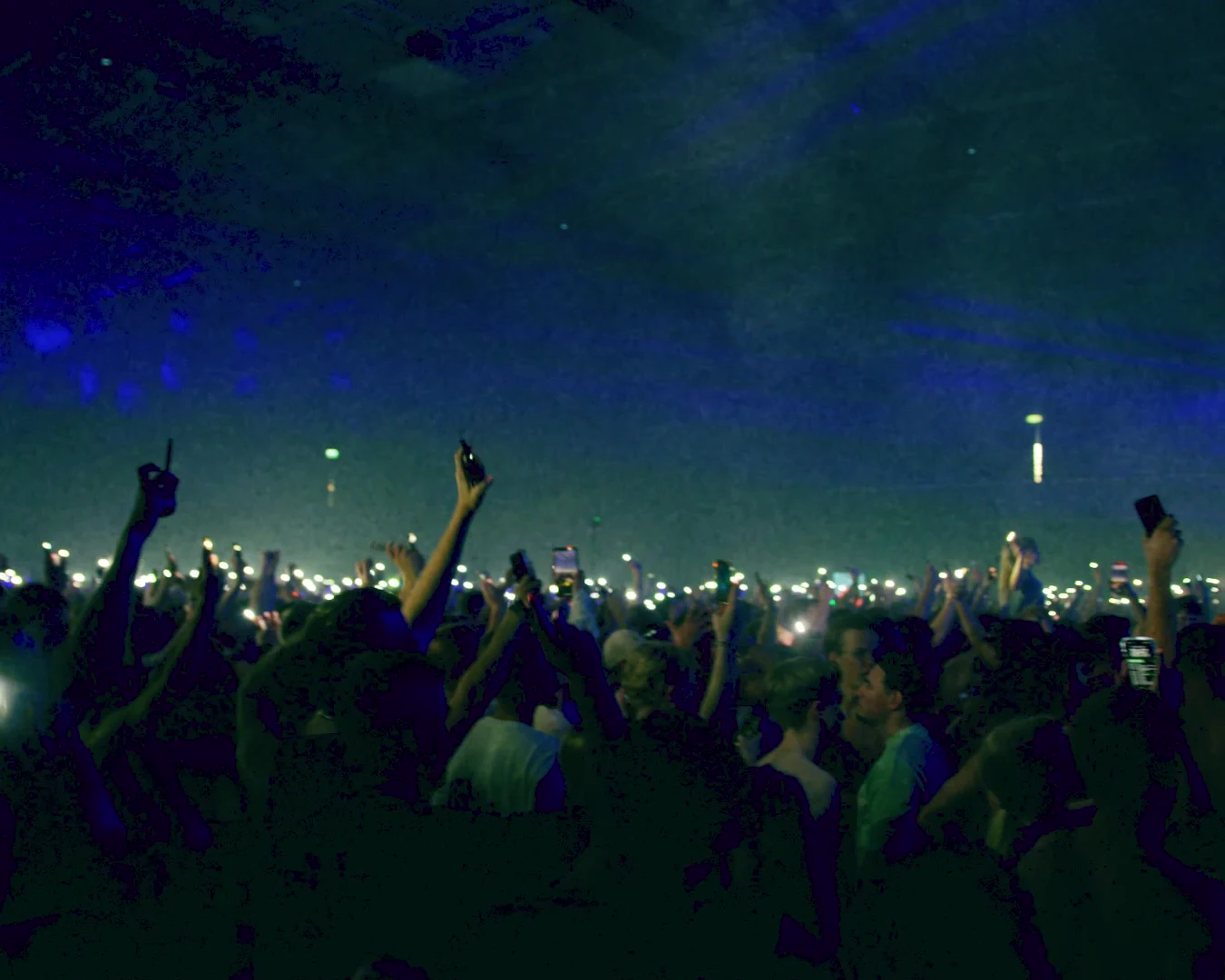
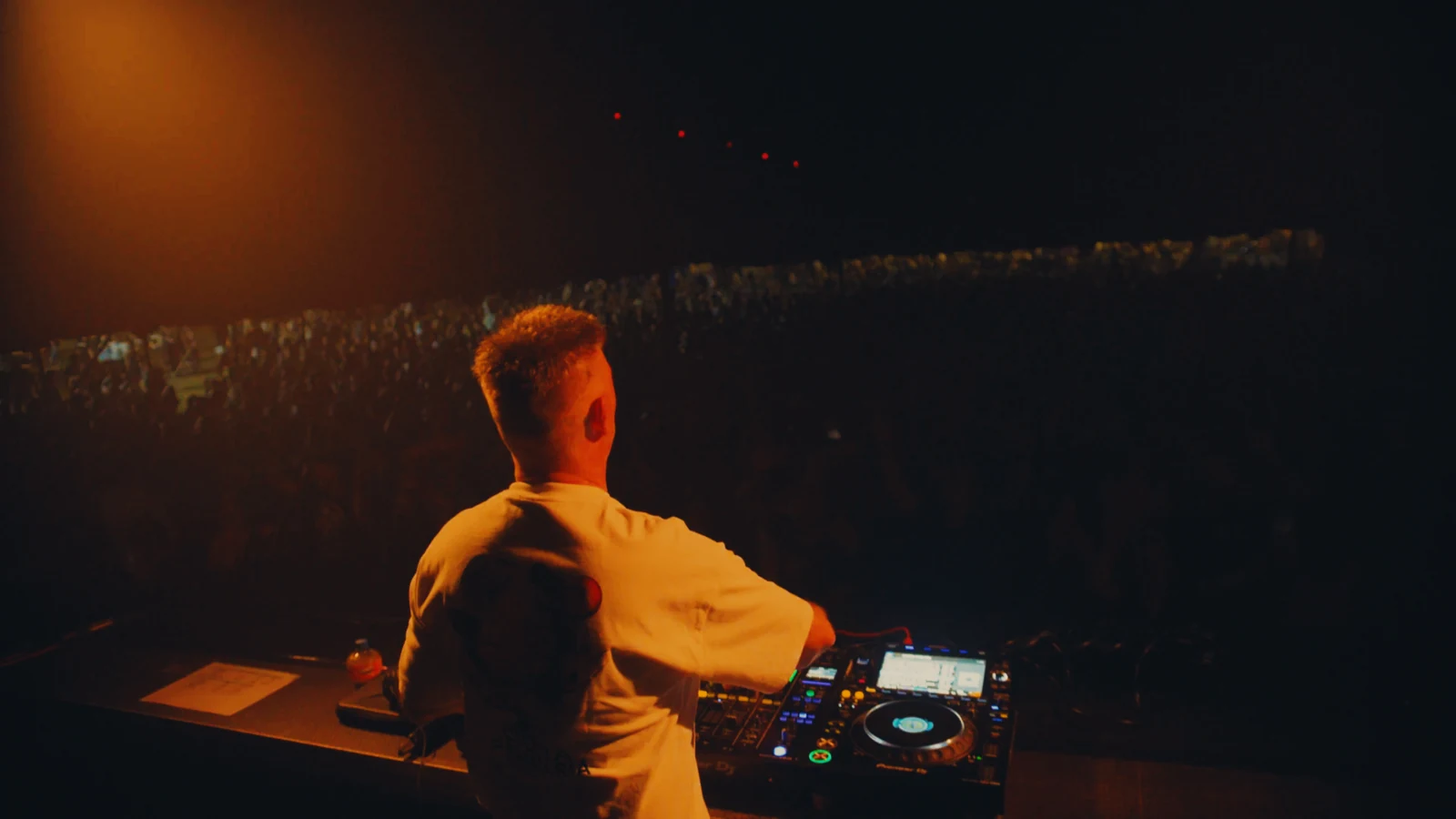
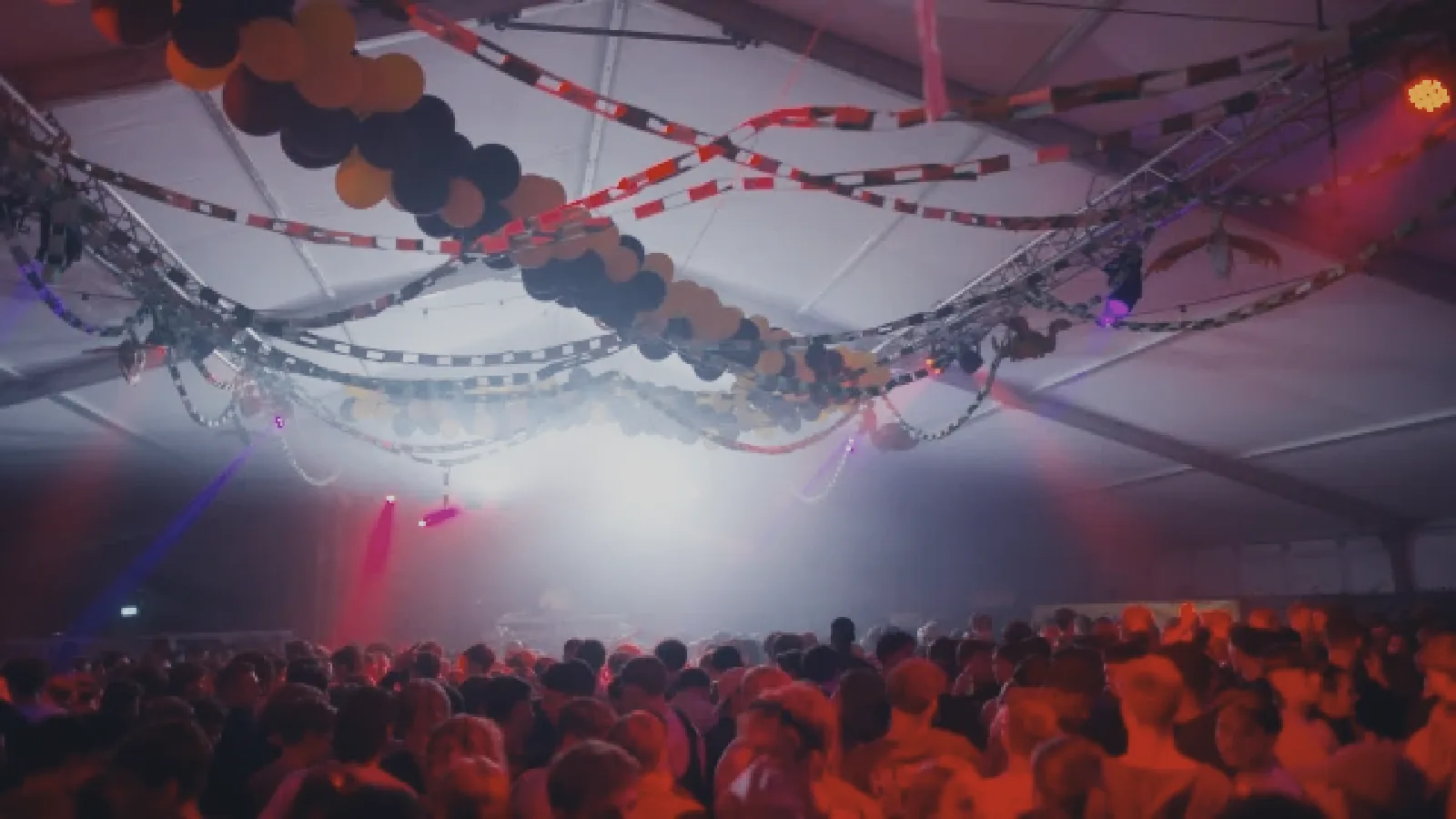
The eighth clip is almost all shadow. The crowd becomes a set of suggestions: a few heads, a few hands, and a dark teal floor full of grain. Where the compressed source breaks into blocks, the dark gradients show it.
The first clip also keeps a cast in its lowest tones. The blacks are teal-gray, not neutral. That lifts the shadows just enough for the haze to read as haze rather than as a void, but it also means the grain sits right on top of the detail.
The sequence
- A close portrait of a shirtless man in red and teal light, an earpiece catching a green light.
- A dancer in a patterned top, lit by a cyan LED wall.
- Smiling faces with glitter on the cheekbones, arms out in blue-green light.
- A wide shot of raised hands and phone lights against the night sky.
- Green laser beams over an amber haze, with silhouetted dancers.
- A shouting crowd in green haze, close and loud.
- A laughing group in dark green light.
- A packed floor in violet and teal, mostly shadow, shot tight into the crowd.
The technical grade: log input, Rec.709 and the 3D LUT
The delivered files are tagged Rec.709, 1350 by 1080 pixels, H.264 at 25 frames per second. What happens before that tag matters more than the tag itself. Footage straight off a camera in a log curve is flat on purpose: it keeps highlight and shadow information that a display curve would throw away. The input transform takes that flat image into a working space, and the creative LUT builds the look on top.
A 3D LUT is the right tool for this, because stage light is not a neat picture. A per-channel curve cannot tell a face under red light from the wall behind it. A 3D LUT maps the whole color space, so it can keep the skin orange-red while the cyan wall stays cyan in the same frame. This is the job the 65×65×65 grid in FestivalLUTs is built for.
The shadow trade-off comes from the bottom of that same curve. Pushing the lowest tones toward black compresses them into fewer code values, and those values are the ones that carry detail. Once they are spent, sensor noise and compression blocks sit at a higher relative level. That is what the eighth clip shows. In an 8-bit delivery there are fewer values left to describe a gradient in the dark, so banding and blocking appear first exactly where the grade has crushed the image.
Leo covers the blue LED side in detail in his post on 450nm stage blues. The short version for this footage: the cyan wall and the violet crowd sit near the edge of what Rec.709 can show, so the grade has to decide what gets compressed and what gets clipped.
What to check in the grade
- Skin under red light. Does the orange hold a face, or does it swamp it? Clip 1 is the test.
- The shadow floor. Does the teal cast read as atmosphere, or as a color cast nobody asked for? Clips 1 and 8 show both sides.
- Laser edges. Do the beams stay sharp against the amber haze? Clip 5 is the test.
- The dark crowd. How much texture can you lift before grain becomes the image? Clip 8 answers that.
Shooting notes for the next party
- Expose for the shadows on purpose. If the dark crowd is the subject, expose for it deliberately. Otherwise the grade decides for you, and the detail goes first.
- Protect the highlights. Lasers and phone torches clip fastest, and a clipped beam cannot be graded back.
- Match the shutter to the LED refresh rate, and check it on the monitor, not with your eye. A flicker band across a wall looks harmless in the viewfinder and ruins the timeline.
- Shoot a short reference clip at the start of each set, with the lights on, so the grade has something to match later.
- Note the color of the LED walls. A wall that changes color between songs will change the grade with it.
Where the LUT stops
A LUT cannot restore detail that was never recorded. It can only decide how the recorded detail is shown. That is why the exposure on the night matters more than any single look. Start from a clean log file, choose a stage look from the public Show LUTs on the site, and adjust from there.
-
Eric
@eric
Senior Festival DP & Lead MōVI Operator
Resident AuthorWrites for the FestivalLUTs blogEarned automatically from what is public on FestivalLUTs. Nobody can buy it or ask for it.2 LUTsShared 2 LUTs on FestivalLUTs.Earned automatically from what is public on FestivalLUTs. Nobody can buy it or ask for it.100 downloadsReached 100 downloads.Earned automatically from what is public on FestivalLUTs. Nobody can buy it or ask for it.StaffOfficial FestivalLUTs staff. Only the people who run this site carry this badge.
Join the discussion: share a setting that worked, or ask the crew.
Sign in to comment